
Adults between 30 and 80 years old who are current smokers or former smokers who quit less than 15 years ago, with at least 10 pack-years of smoking history. You must not currently be receiving cancer treatment and must not have a history of HIV, HCV, or HBV infection. Pregnant individuals are not eligible.
Lung Cancer Clinical Trial in Oklahoma City, OK
A blood test for lung cancer detection to help high-risk smokers get answers before symptoms appear.
Enroll Now
Are you at risk of Lung Cancer
Understanding What Is Lung Cancer and Why Early Detection Matters?
Lung cancer is the leading cause of cancer-related deaths worldwide, with approximately 80% of cases linked to cigarette smoking. What makes it particularly dangerous is how silently it develops as most people experience no symptoms in the early stages, and by the time symptoms do appear, the disease has often already advanced to a late stage where treatment options are limited. For heavy smokers, the risk is significantly elevated, making early detection not just beneficial but potentially life-saving.
Currently, low-dose CT (LD-CT) scanning is the standard tool for lung cancer screening for smokers, yet fewer than 5% of eligible Americans actually get screened each year. Barriers like cost, limited access, radiation concerns, and inconvenience keep millions of high-risk individuals from getting the screening they need. This gap is exactly why lung cancer screening for smokers is focused on finding simpler, more accessible alternatives, like a blood test that can be integrated into routine medical care and reach people before the disease progresses
Our team is conducting detection for lung cancer clinical trial in Oklahoma City, OK to evaluate the efficacy and safety of investigational therapies, offering hope for improved care and outcomes.
Joining the clinical trial is entirely voluntary and comes at no cost.
To find out more about lung cancer detection research, simply complete the form above.
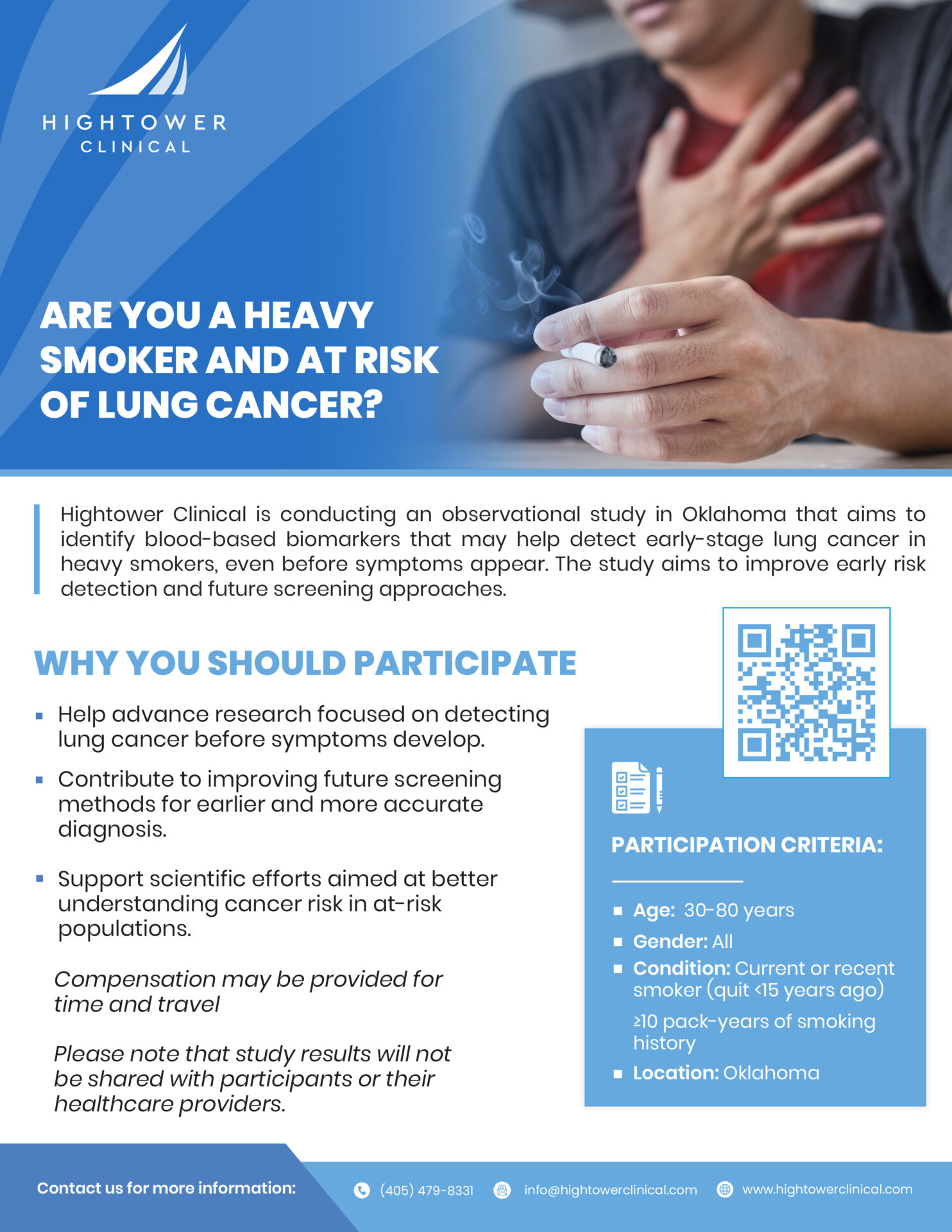
About This Lung Cancer Blood Screening Study
Hightower Clinical is participating in a multi-center observational study focused on the early detection of asymptomatic lung cancer through blood-based biomarkers. Blood samples are analyzed for specific patterns in cell-free DNA and RNA that may distinguish individuals who have lung cancer from those who do not.
This blood test for lung cancer study in Oklahoma City, OK is part of a broader clinical development program working toward an FDA-ready diagnostic tool. Participants contribute blood samples at three points over 24 months, with no changes to their existing medical care. The goal is to build a reliable, non-invasive lung cancer blood screening option that could one day complement or reduce the need for CT-based screening; making early detection more accessible for millions of high-risk smokers across the country.
All study-related procedures and treatments, including the investigational drug, are offered free of charge, with no insurance required for participation.
The study doctor will support you throughout the clinical trial, addressing any questions you have about the study and treatment before you make your decision to participate.
Research for Lung Cancer Detection: What to Expect From This Blood Test for Lung Cancer
Participating in this study is straightforward and involves minimal disruption to your daily life. At your first visit, you will review and sign an informed consent form, provide your medical and smoking history, and have a blood sample collected. You will then return for two follow-up visits at the 12-month and 24-month marks, where an additional blood sample will be collected and your health status will be documented. No treatments, medications, or procedures outside of a routine blood draw are involved at any point.
Your participation contributes entirely to the advancement of lung cancer detection research and future screening tools. You may be compensated for your time and travel, and you are free to withdraw from the study at any time without affecting your current or future medical care.
*Study-related care is offered at no charge. Expert physicians and healthcare professionals conduct thorough physical exams and assessments.*

Age
30-80 Years
Gender
All
Condition
Lung Cancer
Current Status
Recruiting
What Happens in Lung Cancer?
Lung cancer develops when abnormal cells in the lungs grow uncontrollably, often triggered by long-term exposure to the carcinogens found in cigarette smoke. Heavy smokers, defined as those with 20 or more pack-years of smoking history face a significantly higher lifetime risk compared to non-smokers. What makes it especially difficult to catch early is that the lungs have no pain receptors, so tumors can grow for years without any noticeable symptoms.
Risks of Undetected Lung Cancer
- Cancer can spread silently before symptoms appear
- Tumors may grow undetected in early stages
- Late detection dramatically reduces survival and recovery chances
- High-risk smokers often go unscreened for years
- Advanced cancer limits eligibility for curative surgery
- Delayed diagnosis increases likelihood of cancer spreading to organs
Complications of Lung Cancer
- Cancer can spread to the brain, liver, and bones
- Breathing difficulties worsen significantly as tumors grow larger
- COPD and emphysema complicate lung cancer treatment outcomes
- Chemotherapy and radiation cause fatigue, nausea, and hair loss
- Advanced lung cancer can lead to severe weight loss
- Respiratory failure is a common complication in late-stage patients
Frequently Asked Questions
What does the blood test for lung cancer involve?
Just a routine blood draw and there are no medications, injections, or imaging procedures involved. The sample is sent to a central laboratory for analysis of blood-based biomarkers for lung cancer.
Will I find out my results?
No. This is a research study and results from your blood sample will not be returned to you or your healthcare provider. Your contribution goes entirely toward advancing the science of early lung cancer detection.
How long does the study last and how many visits are required?
The study involves three visits over 24 month; a baseline visit and follow-up visits at 12 and 24 months. Each visit primarily involves a blood draw and a review of your health and cancer status.
Is there any risk to participating?
The risks are minimal and limited to those associated with a routine blood draw, such as minor discomfort, bruising, or lightheadedness at the collection site. No experimental treatments or devices are used on participants.
Will my participation affect my medical care?
No. This is an observational study only. Your standard medical care continues completely unchanged, and you may withdraw at any time without any impact on your treatment or relationship with your healthcare provider.
Unlock New Opportunities in Clinical Research - Join Today!
We're here and eager to assist. Reach out to Hightower Clinical Research in Oklahoma City, OK for further details on how we can support you.


Get Involved Today!
© Copyright 2026 – Hightower Clinical. CREATED BY DIGITAL AUXILIUS.